


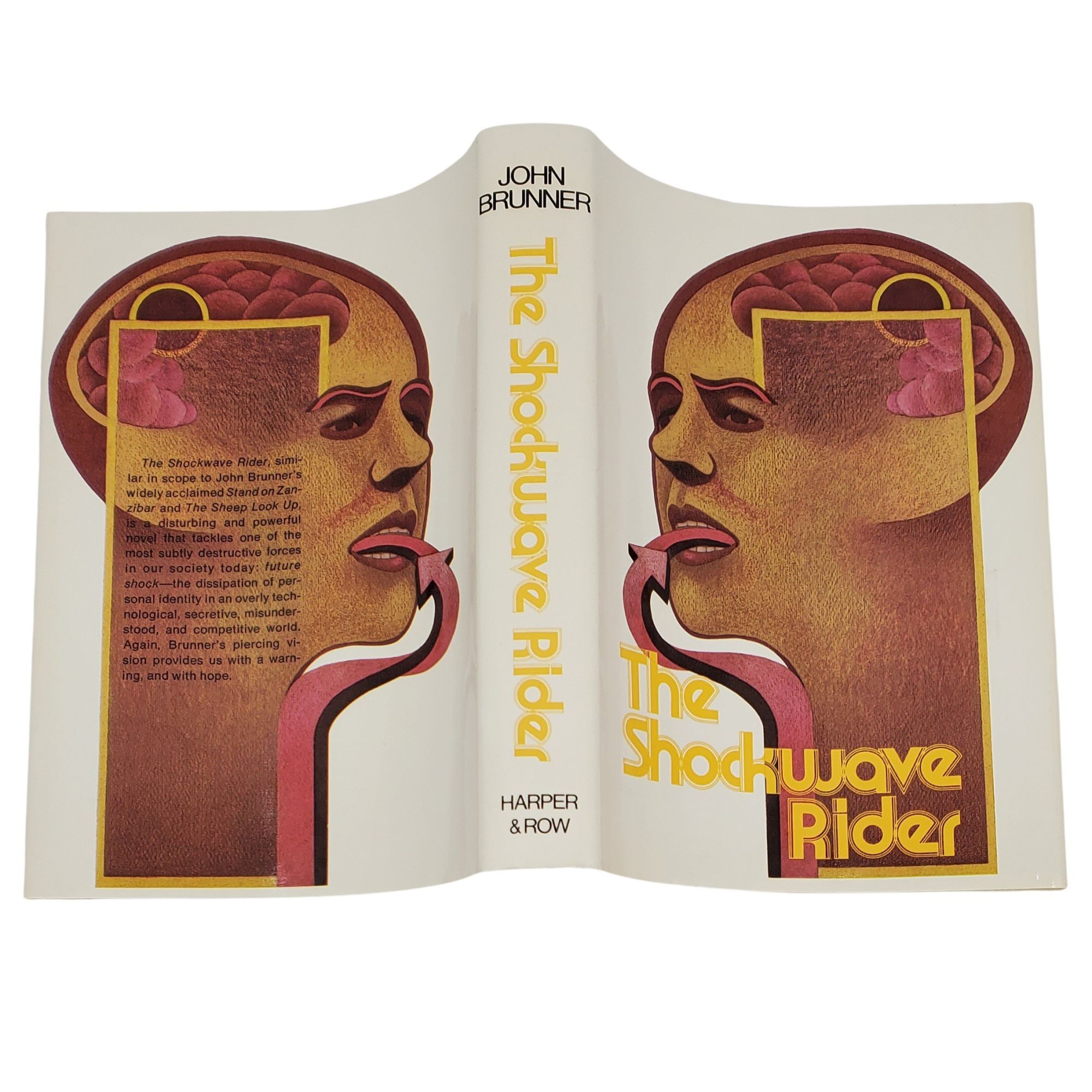


The Shockwave Rider
First edition, 1975
The Shockwave Rider (1975) closes John Brunner's dystopian quartet and is the entry most directly rooted in a single non-fiction source. Brunner acknowledged in his opening pages that the novel derives largely from Alvin Toffler's Future Shock (1970), which argued that accelerating social and technological change was producing a new kind of psychological stress. The novel is set in a near-future America where a vast, integrated data network governs identity, credit, employment, and surveillance, and where most people cope with constant change by cycling through disposable "plug-in" lifestyles and identities. Nick Haflinger, raised from childhood inside Tarnover, a secret government think tank, has escaped the system and has been living under a series of false identities ever since. The novel opens with him already captured and under interrogation, and moves between that interrogation and the events that led to it. The book coined the term "worm" for a self-replicating program loose in a computer network, a coinage that passed into genuine technical usage. As the final act of his career as a fugitive, Haflinger releases into the national data network the largest such worm ever written, designed to make suppressed information about corporate and government corruption available to anyone with a terminal. The three novels preceding this one end in catastrophe or grim stasis; The Shockwave Rider is the only entry in the quartet with something approaching hope.
Hardcover. First Edition, First Printing. Octavo, cloth-backed boards. New York: Harper & Row, 1975. ISBN: 0060105593. #10031.
Fine in fine dust jacket.
Hardcover. First Edition, First Printing. Octavo, cloth-backed boards. New York: Harper & Row, 1975. ISBN: 0060105593. #10031.
Fine in fine dust jacket.
Additional Details
By the time Brunner wrote The Shockwave Rider, he had already spent the better part of a decade building what would become his quartet's most consistent preoccupation: the gap between the speed at which technology and institutions change and the capacity of ordinary people to understand or respond to those changes. Stand on Zanzibar had addressed information overload; The Shockwave Rider goes further, asking what happens to individual identity when the systems that define a person, employment records, credit codes, residential histories, official credentials, can all be fabricated or erased.
The novel's debt to Alvin Toffler is explicit and acknowledged. Toffler's Future Shock had argued in 1970 that the defining psychological condition of modern life was the disorientation produced by change too rapid to assimilate, and that individuals were responding by either retreating into nostalgia and tribalism or by cultivating a kind of disposability, attaching themselves to people, places, and things only temporarily before moving on. Brunner took both of these responses and built them into the architecture of his imagined America. The "tribes" in the novel are literal: urban communities organized around shared belief systems, named things like the Billy-kings (Protestant) and the Jihad Babies (Muslim), who stake territorial claims in neighborhoods and exist in uneasy truce with one another. The "plug-in" lifestyle is the other pole: a culture in which renting rather than owning, moving rather than staying, and reinventing rather than developing are the norm, facilitated by a data network that can provision a new identity in hours.
Nick Haflinger is the system's most capable product and its most dangerous enemy. Raised at Tarnover, a classified government installation devoted to identifying and cultivating exceptional minds, he was trained from childhood to inhabit whatever role the state required of him. He eventually escaped and has since used those same skills to sustain a series of fabricated identities across the national network, each one fully documented, each one abandoned when the authorities close in. The novel's structure reinforces his situation: it moves between interrogation sessions, in which his captors try to extract his history, and the narrative of that history itself, so that the reader is always watching two versions of Haflinger simultaneously, the one being questioned and the one who has not yet been caught.
The book's most lasting contribution to the vocabulary of computing is the "worm," introduced here as a term for a self-replicating program that propagates through a network, eating data or executing commands as it goes. Brunner's worms range from the mundane, short programs used to track or sabotage a single individual's credit code, to Haflinger's final act: a parthenogenetic worm of unprecedented scale, designed to open every secure government and corporate database and route suppressed information about bribery, tax evasion, public health violations, and environmental crimes to every printout terminal on the continent. The worm does not destroy the network; it makes the network honest. It is an act of radical transparency rather than sabotage, and Brunner frames it as the logical conclusion of everything Haflinger has learned about how information is weaponized by those who control its flow.
Related to the worm, though distinct from it, is the novel's other significant invention: Hearing Aid, an anonymous telephone service accessible by dialing ten nines, where anyone in distress can speak to a blank screen and be heard without judgment, advice, or fee. The service is maintained by the community of Precipice, a small intentional town that serves as the novel's image of what a functional society might look like: local, accountable, ungoverned by hypercorporations. Precipice and Hearing Aid exist as quiet proof that the system Haflinger is fighting against is not inevitable.
The Shockwave Rider is the only novel in the quartet that allows its protagonist to win, or something close to it. Where Stand on Zanzibar ends in uneasy equilibrium, The Jagged Orbit in tenuous resolution, and The Sheep Look Up in smoke and collapse, this novel ends with Haflinger's worm running free and the people of Precipice voting on two propositions: that poverty and hunger are unworthy of a rich planet, and that no one should gain illicit advantage from the fact that institutions collectively know more than any individual can. Brunner asks the reader directly how they voted. After the unrelieved bleakness of The Sheep Look Up, this ending registers as genuinely hopeful, though Brunner had learned enough by 1975 to leave the outcome of the vote unrecorded.
Related items


