


The Three Stigmata of Palmer Eldritch
Second American paperback, 1971
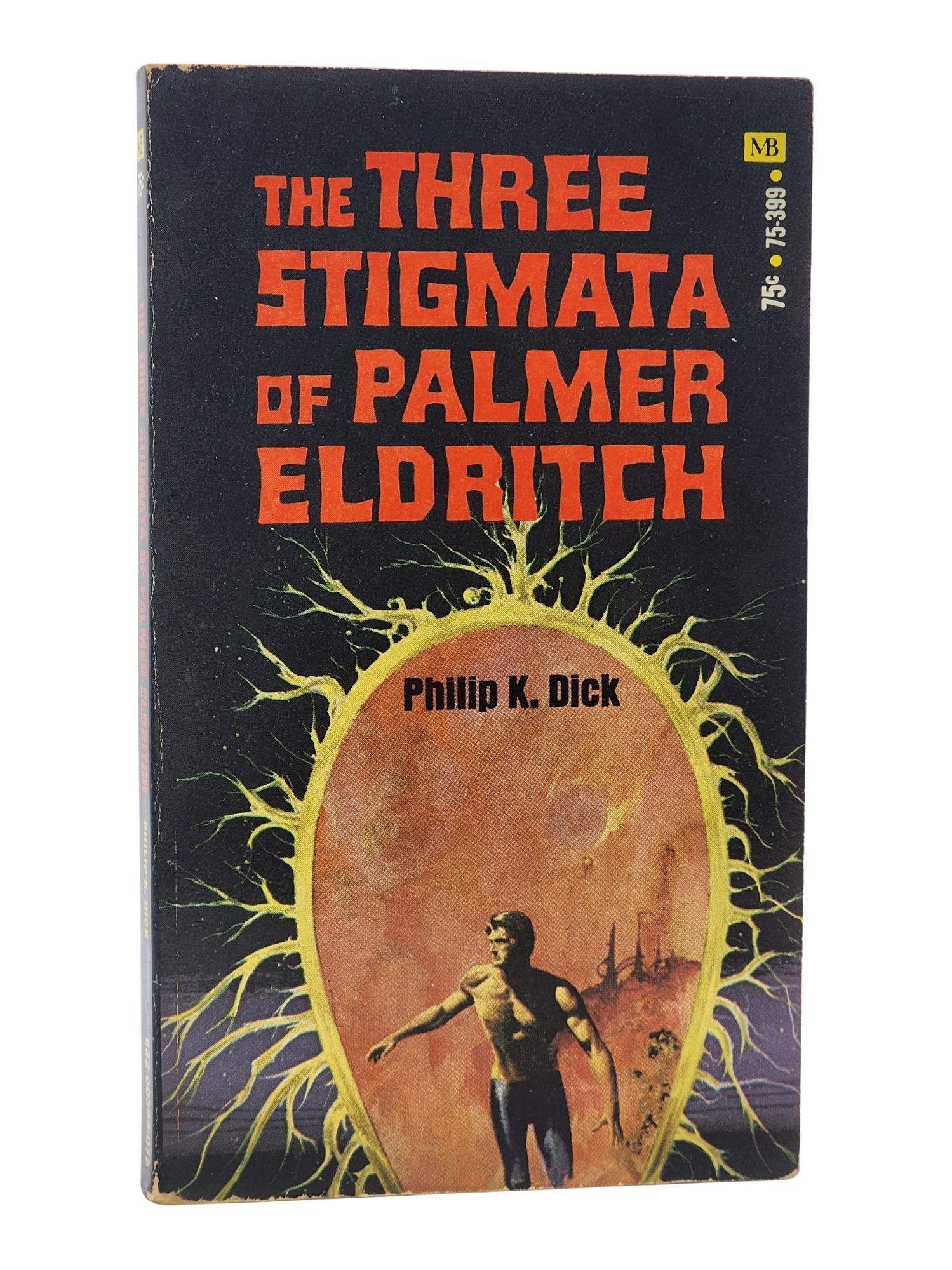
The Three Stigmata of Palmer Eldritch (1965) is one of Philip K. Dick's most important novels, a hallucinatory exploration of corporate control, false reality, and religious experience set among colonists on Mars who escape their miserable lives through a shared drug-induced hallucination. This is the second American paperback edition, a MacFadden reissue with a new cover design. Somewhat uncommon.
Softcover. First Paperback Edition, Second Printing. MacFadden 75-399 ($0.75). Cover art by Jack Faragasso. New York: MacFadden, 1971. Pringle, Science Fiction: The 100 Best Novels (44). Jones & Newman, Horror: The 100 Best Novels (61). Levack 40h. Wintz & Hyde SF27.4. #11022.
Really nice, fine copy with only minute wear to extremities.
Softcover. First Paperback Edition, Second Printing. MacFadden 75-399 ($0.75). Cover art by Jack Faragasso. New York: MacFadden, 1971. Pringle, Science Fiction: The 100 Best Novels (44). Jones & Newman, Horror: The 100 Best Novels (61). Levack 40h. Wintz & Hyde SF27.4. #11022.
Really nice, fine copy with only minute wear to extremities.
Additional Details
The Three Stigmata of Palmer Eldritch (1965) is one of Philip K. Dick's most hallucinatory novels and one of the most sustained explorations of false reality in his entire body of work. The novel is set in a near future where rising global temperatures have made Earth increasingly uninhabitable, and the UN is forcibly conscripting people for relocation to Mars and other colonies. Life on the colonies is bleak and claustrophobic. The colonists' primary relief is Can-D, an illegal drug distributed by Perky Pat Layouts, Inc., which allows users to collectively inhabit a shared hallucination built around the accessories of a Barbie-like doll named Perky Pat. Users dissolve briefly into a simulacrum of a comfortable, mid-century American life that no longer exists.
Barney Mayerson works as a precognitive consultant for Perky Pat Layouts, identifying which new accessories will prove most desirable to the colonists who depend on the drug for psychological survival. He has just received his draft notice for Mars. Into this situation arrives Palmer Eldritch, a powerful industrialist who has returned from a ten-year journey to the Proxima system with something new, a drug called Chew-Z, which he claims will supersede Can-D entirely. Where Can-D offers a shared, temporary escape, Chew-Z offers something far more disturbing, a private, potentially permanent reality that may involve Eldritch himself as its controlling presence.
The three stigmata of the title are the physical markers that begin appearing on people who have taken Chew-Z: artificial eyes with slitted pupils, a mechanical arm, and teeth of stainless steel. They are the visible signs of Eldritch's possible contamination or possession of his users, and the novel ruminates on whether what Eldritch is offering constitutes a genuine religious experience, a form of demonic possession, or simply a more efficient means of corporate control over human consciousness. Dick never resolves any of this cleanly.
The novel was written in 1964 and Dick later said he believed he had accidentally written a genuine theological work without fully understanding what he was doing. The question of whether Eldritch is God, the Devil, an alien intelligence, or simply a very dangerous drug dealer haunts the book's final pages and lingers beyond. First published in hardcover by Doubleday in 1965.
Barney Mayerson works as a precognitive consultant for Perky Pat Layouts, identifying which new accessories will prove most desirable to the colonists who depend on the drug for psychological survival. He has just received his draft notice for Mars. Into this situation arrives Palmer Eldritch, a powerful industrialist who has returned from a ten-year journey to the Proxima system with something new, a drug called Chew-Z, which he claims will supersede Can-D entirely. Where Can-D offers a shared, temporary escape, Chew-Z offers something far more disturbing, a private, potentially permanent reality that may involve Eldritch himself as its controlling presence.
The three stigmata of the title are the physical markers that begin appearing on people who have taken Chew-Z: artificial eyes with slitted pupils, a mechanical arm, and teeth of stainless steel. They are the visible signs of Eldritch's possible contamination or possession of his users, and the novel ruminates on whether what Eldritch is offering constitutes a genuine religious experience, a form of demonic possession, or simply a more efficient means of corporate control over human consciousness. Dick never resolves any of this cleanly.
The novel was written in 1964 and Dick later said he believed he had accidentally written a genuine theological work without fully understanding what he was doing. The question of whether Eldritch is God, the Devil, an alien intelligence, or simply a very dangerous drug dealer haunts the book's final pages and lingers beyond. First published in hardcover by Doubleday in 1965.
Related items


