
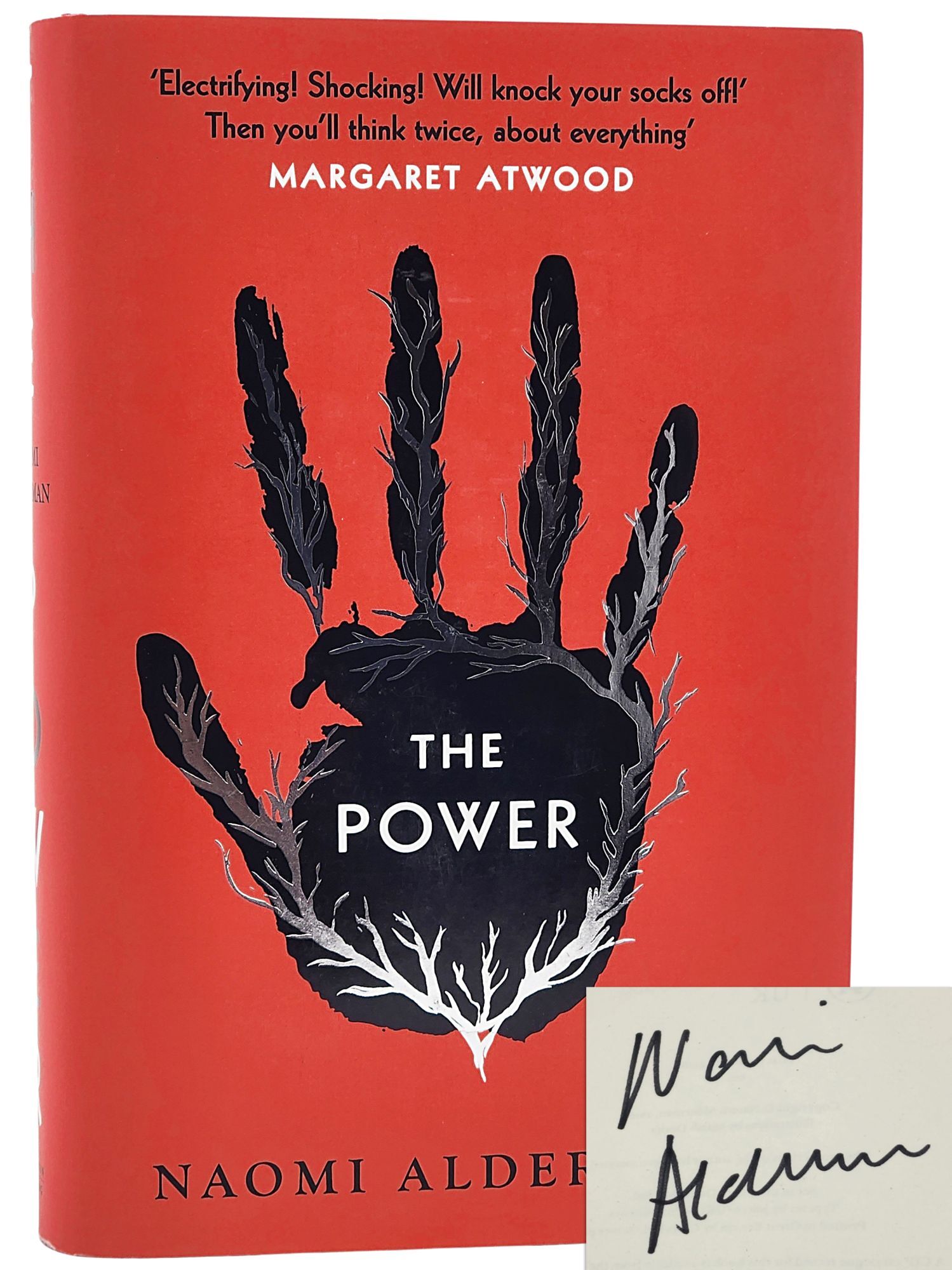


Signed
The Power
Signed British first edition, 2016
Naomi Alderman's The Power (2016) imagines a world in which adolescent girls begin developing the ability to generate and direct electrical current through their bodies, capable of causing pain, injury, or death. As the ability spreads and proves to be inheritable, the existing structures of social, political, and religious authority begin to buckle. The novel follows four characters across different countries and circumstances as the shift accelerates from isolated incidents to something that reshapes civilization entirely. Alderman was chosen by Margaret Atwood as her mentee through the Rolex Mentor and Protégé Arts Initiative, and Atwood's influence is felt throughout the novel. Winner of the 2017 Baileys Women's Prize for Fiction.
Signed copy. Signed by Alderman on the title page.
Hardcover. First Edition, First Printing. Octavo, decorated red cloth boards. London: Viking Penguin Books, 2016. Bailey's Women's Price for Fiction winner (2017). ISBN: 9780670919987. #11121.
Fine in fine dust jacket.
Signed copy. Signed by Alderman on the title page.
Hardcover. First Edition, First Printing. Octavo, decorated red cloth boards. London: Viking Penguin Books, 2016. Bailey's Women's Price for Fiction winner (2017). ISBN: 9780670919987. #11121.
Fine in fine dust jacket.
Additional Details
The Power is presented as a historical novel written by a man named Neil, reconstructing events from thousands of years in the past. His correspondent, a woman named Naomi, reads the manuscript and responds with editorial notes. The novel ends with her suggestion that Neil consider publishing under a woman's name, given the difficulties male writers face in having their work taken seriously. Note that the fictional author Neil Adam Armon's name is an anagram of real author Naomi Alderman.
The events Neil reconstructs follow four characters. Roxy is a teenager in London, the daughter of a crime boss, who discovers the ability during a violent home invasion that kills her mother. Tunde is a young Nigerian journalist who films early incidents and uploads them, becoming one of the primary documentarians of the transformation as it spreads globally. Margot is an American politician who learns to use the power shift for her own advancement, moving from city mayor to governor while managing the public's anxiety about the new order. And Allie is a girl escaping an abusive foster home in the American South who reinterprets the ability as divine purpose, builds a religious following, and eventually becomes Mother Eve, the spiritual figurehead of a new faith whose scripture casts women as the rightful inheritors of the earth.
The ability itself, described as the skein, is an organ that runs along the collarbone, and it can be awakened in older women by younger ones who already carry the charge. Within a few years it is effectively universal among women, and men have lost the physical advantage that shaped most of recorded history. What follows is not a utopia. Alderman is careful and deliberate on this point. The violence that emerges as women consolidate power mirrors the violence of the world being displaced. In the fictional Eastern European state of Bessapara, a matriarchal regime takes hold that is brutal and authoritarian. Trafficking networks reorganize with men as the primary victims. Religious doctrine is rewritten to accommodate the new facts of power rather than to question them.
The comparison to The Handmaid's Tale is almost inescapable, and the novel is aware of it. Like Atwood, Alderman frames her narrative as a historical reconstruction assembled long after the events it describes, complete with inserted correspondence, pseudo-archival documents, and the detached analytical tone of scholars examining events of the distant past. The future academics who have inherited this world treat its violence as historical inevitability. For the reader who has just watched the escalation unfold in real time, their certainty is among the book's more unsettling effects.
Where Atwood's epilogue uses scholarly distance to show how the trauma of the oppressed gets sanitized by history, Alderman's framing device operates as a kind of mirror. The novel's fictional historian is a man writing about a world that ended male dominance, advised to disguise his gender to reach an audience. The reversal is precise and pointed, and it reframes everything that precedes it. The Power is not finally an argument that women given power would do better than men. It is an argument that the relevant variable was never gender at all.
The Power was adapted as a television series for Amazon Prime, airing in 2023.
The events Neil reconstructs follow four characters. Roxy is a teenager in London, the daughter of a crime boss, who discovers the ability during a violent home invasion that kills her mother. Tunde is a young Nigerian journalist who films early incidents and uploads them, becoming one of the primary documentarians of the transformation as it spreads globally. Margot is an American politician who learns to use the power shift for her own advancement, moving from city mayor to governor while managing the public's anxiety about the new order. And Allie is a girl escaping an abusive foster home in the American South who reinterprets the ability as divine purpose, builds a religious following, and eventually becomes Mother Eve, the spiritual figurehead of a new faith whose scripture casts women as the rightful inheritors of the earth.
The ability itself, described as the skein, is an organ that runs along the collarbone, and it can be awakened in older women by younger ones who already carry the charge. Within a few years it is effectively universal among women, and men have lost the physical advantage that shaped most of recorded history. What follows is not a utopia. Alderman is careful and deliberate on this point. The violence that emerges as women consolidate power mirrors the violence of the world being displaced. In the fictional Eastern European state of Bessapara, a matriarchal regime takes hold that is brutal and authoritarian. Trafficking networks reorganize with men as the primary victims. Religious doctrine is rewritten to accommodate the new facts of power rather than to question them.
The comparison to The Handmaid's Tale is almost inescapable, and the novel is aware of it. Like Atwood, Alderman frames her narrative as a historical reconstruction assembled long after the events it describes, complete with inserted correspondence, pseudo-archival documents, and the detached analytical tone of scholars examining events of the distant past. The future academics who have inherited this world treat its violence as historical inevitability. For the reader who has just watched the escalation unfold in real time, their certainty is among the book's more unsettling effects.
Where Atwood's epilogue uses scholarly distance to show how the trauma of the oppressed gets sanitized by history, Alderman's framing device operates as a kind of mirror. The novel's fictional historian is a man writing about a world that ended male dominance, advised to disguise his gender to reach an audience. The reversal is precise and pointed, and it reframes everything that precedes it. The Power is not finally an argument that women given power would do better than men. It is an argument that the relevant variable was never gender at all.
The Power was adapted as a television series for Amazon Prime, airing in 2023.