
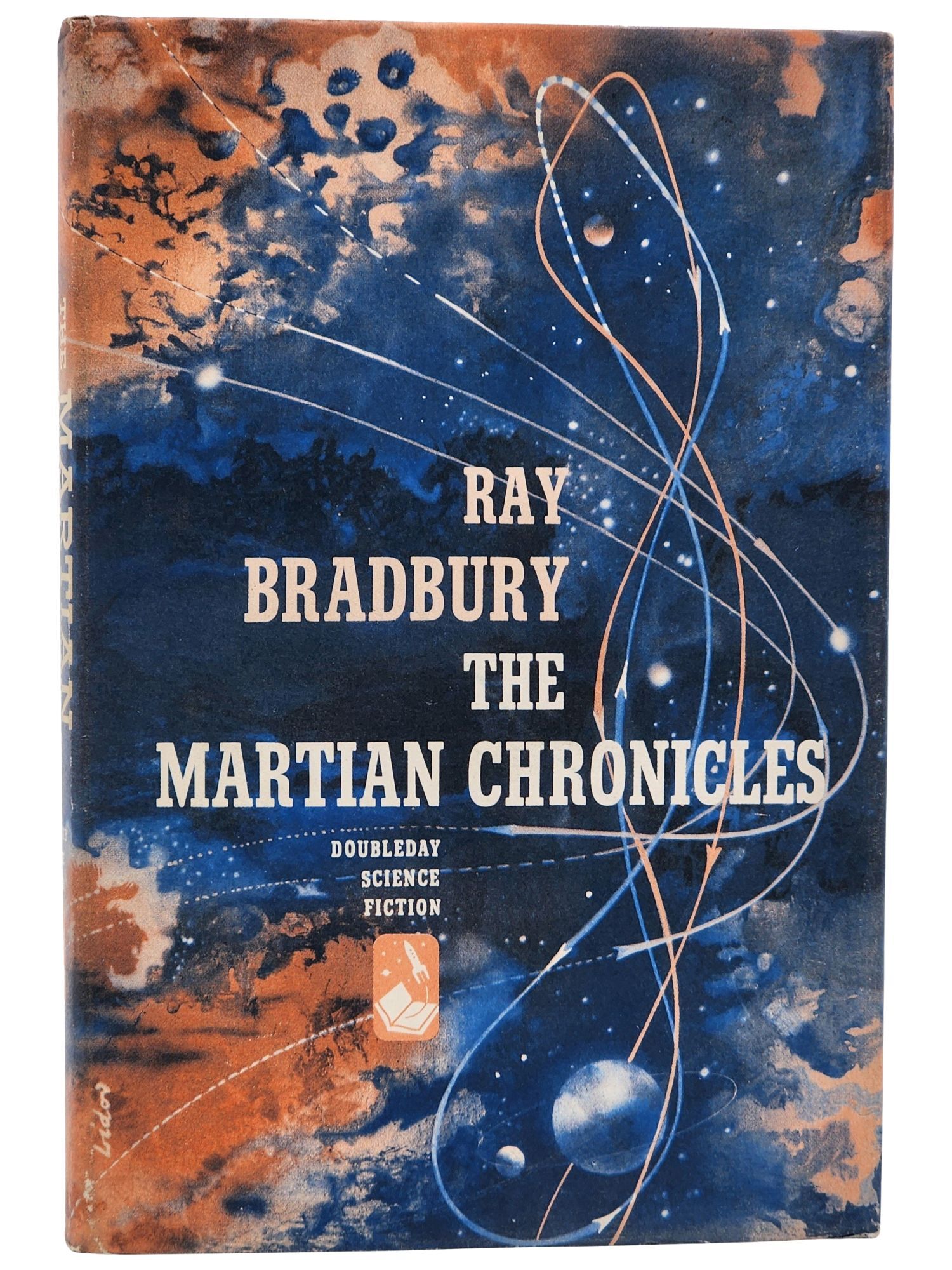


The Martian Chronicles
First edition, 1950
The Martian Chronicles (1950) is an interlinked cycle of stories tracing humanity's colonization of Mars across several decades of the near future. Bradbury structured the book as a kind of chronicle, with dated chapter headings advancing from 1999 through 2026, giving the accumulated stories the feel of a history rather than a conventional narrative. The settlers arrive carrying the ideals, prejudices, and appetites of mid-century America, and what they do to Mars is what they have always done: rename it, exploit it, and ruin it. Stories such as "Way Up in the Middle of the Air," "There Will Come Soft Rains," and "Usher II" give the collection much of its moral and dystopian weight. The book ends with a small family burning their papers from Earth on the bank of a Martian canal, the father pointing at their own reflections in the water when his children ask to see the Martians. First published by Doubleday in May 1950, this first edition contains "Usher II," a story dropped from some later printings and from British editions published under the title The Silver Locusts, making the first edition the most complete text of the work as Bradbury assembled it.
Hardcover. First Edition, First Printing. Octavo, cloth. Garden City, NY: Doubleday & Company, 1950. Pringle, Science Fiction: The 100 Best Novels (3). #11376.
Fine in fine dust jacket.
Hardcover. First Edition, First Printing. Octavo, cloth. Garden City, NY: Doubleday & Company, 1950. Pringle, Science Fiction: The 100 Best Novels (3). #11376.
Fine in fine dust jacket.
Additional Details
The Martian Chronicles is structured as a history that never happened, its chapters headed by dates running from January 1999 through October 2026, each marking a stage in humanity's colonization of Mars. The form matters: by presenting the stories as a chronicle rather than a novel, Bradbury gives the accumulating disasters the feeling of inevitability, as if each expedition, each settlement, each erasure were simply the next entry in a record that could only end one way.
The Martians die early and almost incidentally. The first human expeditions carry chicken pox, and a civilization that built cities of crystal and tile and philosophy for a million years is undone by a child's disease. Jeff Spender, the archaeologist on the third expedition, is the one who stops to register what this means. He walks the empty cities alone for days, teaches himself to read the ancient script, and comes back a man who has declared himself the last Martian. He kills several of his crewmates before Captain Wilder hunts him down. In their final conversation, conducted with cigarettes on a hillside while the rest of the crew closes in, Spender lays out the case against what is coming. He has walked those cities, he tells Wilder. He would be glad to call those people his ancestors. What the Earth will bring to Mars is what it brought to Mexico with Cortez: greedy, righteous bigots and atom bomb depots. Wilder understands him well enough to pursue him carefully, to want him dead without unnecessary mess. He shoots Spender himself rather than leave it to someone who wouldn't. Then the expeditions continue.
What follows is a portrait of Midcentury America transported to another planet. The settlers bring their commercial appetites, their racial hierarchies, their Cold War fears, and their tendencies for renaming things. In "Way Up in the Middle of the Air," the entire Black population of the American South announces it is leaving for Mars. Samuel Teece, the hardware store proprietor, spends the story trying to find legal pretexts to stop individuals from going, clinging to old leverage in a situation that has dissolved it. No one stops. The story does not sentimentalize the departure or render it triumphant; it simply records what happens when an exit becomes available to people who have long needed one.
"Usher II" is the collection's most explicit statement about what a culture destroys when it decides certain kinds of imagination are dangerous. Stendahl, a wealthy lover of fantasy literature, has watched Earth's "Moral Climate" authorities burn every work of horror, fantasy, and uncanny fiction. Poe, Bierce, Lovecraft, the Brothers Grimm: all of it gone. On Mars, beyond their jurisdiction, he builds a precise replica of the House of Usher and invites the censors to a party, killing them one by one using the death devices from the stories they destroyed. It is a revenge fantasy, but it is also a catalogue of losses, and it sits in the collection as a direct precursor to Fahrenheit 451, where the same argument is made at novel length with less blood and more grief.
"There Will Come Soft Rains," which takes its title from a Sara Teasdale poem about nature's indifference to human extinction, describes a fully automated house in Allendale, California, on August 4, 2026. The house makes breakfast, cleans its rooms, tends the garden, and reads poetry aloud to no one. The family that lived there is gone, their silhouettes burned into the west wall by whatever happened to the city around them. The house does not know they are dead. It goes on performing its routines until a fire starts and the house burns too, its last voice fading mid-sentence. Bradbury writes no human characters into the story at all. The technology that was supposed to serve and protect the family outlasts them by a few hours and then joins them, just as faithfully useless at the end as it was at the beginning.
The book closes with "The Million-Year Picnic," in which a former state governor has secretly brought his family to Mars under the pretext of a fishing trip. Earth is gone. The radio has gone silent. He burns his papers from the old world one by one on the bank of a canal, government bonds, business graphs, war digests, a map of the world, and tells his children what it all meant: science ran too far ahead, and people got lost in a mechanical wilderness, emphasizing machines over how to run them. When the youngest child asks to see a Martian, the father leads the family to the canal's edge and points at their own reflections.
First published by Doubleday in 1950, The Martian Chronicles drew on stories Bradbury had been publishing in pulp magazines since the mid-1940s, stitched together with newly written interstitial pieces into something that functioned as neither a novel nor a conventional collection. British editions, published under the title The Silver Locusts, omitted several stories including "Usher II," altering the book's thematic balance in ways that persist in some later reprints. The American first edition represents the work as Bradbury intended it: a full account of what happens when a civilization carries its worst habits to a new world and calls the result progress.
The Martians die early and almost incidentally. The first human expeditions carry chicken pox, and a civilization that built cities of crystal and tile and philosophy for a million years is undone by a child's disease. Jeff Spender, the archaeologist on the third expedition, is the one who stops to register what this means. He walks the empty cities alone for days, teaches himself to read the ancient script, and comes back a man who has declared himself the last Martian. He kills several of his crewmates before Captain Wilder hunts him down. In their final conversation, conducted with cigarettes on a hillside while the rest of the crew closes in, Spender lays out the case against what is coming. He has walked those cities, he tells Wilder. He would be glad to call those people his ancestors. What the Earth will bring to Mars is what it brought to Mexico with Cortez: greedy, righteous bigots and atom bomb depots. Wilder understands him well enough to pursue him carefully, to want him dead without unnecessary mess. He shoots Spender himself rather than leave it to someone who wouldn't. Then the expeditions continue.
What follows is a portrait of Midcentury America transported to another planet. The settlers bring their commercial appetites, their racial hierarchies, their Cold War fears, and their tendencies for renaming things. In "Way Up in the Middle of the Air," the entire Black population of the American South announces it is leaving for Mars. Samuel Teece, the hardware store proprietor, spends the story trying to find legal pretexts to stop individuals from going, clinging to old leverage in a situation that has dissolved it. No one stops. The story does not sentimentalize the departure or render it triumphant; it simply records what happens when an exit becomes available to people who have long needed one.
"Usher II" is the collection's most explicit statement about what a culture destroys when it decides certain kinds of imagination are dangerous. Stendahl, a wealthy lover of fantasy literature, has watched Earth's "Moral Climate" authorities burn every work of horror, fantasy, and uncanny fiction. Poe, Bierce, Lovecraft, the Brothers Grimm: all of it gone. On Mars, beyond their jurisdiction, he builds a precise replica of the House of Usher and invites the censors to a party, killing them one by one using the death devices from the stories they destroyed. It is a revenge fantasy, but it is also a catalogue of losses, and it sits in the collection as a direct precursor to Fahrenheit 451, where the same argument is made at novel length with less blood and more grief.
"There Will Come Soft Rains," which takes its title from a Sara Teasdale poem about nature's indifference to human extinction, describes a fully automated house in Allendale, California, on August 4, 2026. The house makes breakfast, cleans its rooms, tends the garden, and reads poetry aloud to no one. The family that lived there is gone, their silhouettes burned into the west wall by whatever happened to the city around them. The house does not know they are dead. It goes on performing its routines until a fire starts and the house burns too, its last voice fading mid-sentence. Bradbury writes no human characters into the story at all. The technology that was supposed to serve and protect the family outlasts them by a few hours and then joins them, just as faithfully useless at the end as it was at the beginning.
The book closes with "The Million-Year Picnic," in which a former state governor has secretly brought his family to Mars under the pretext of a fishing trip. Earth is gone. The radio has gone silent. He burns his papers from the old world one by one on the bank of a canal, government bonds, business graphs, war digests, a map of the world, and tells his children what it all meant: science ran too far ahead, and people got lost in a mechanical wilderness, emphasizing machines over how to run them. When the youngest child asks to see a Martian, the father leads the family to the canal's edge and points at their own reflections.
First published by Doubleday in 1950, The Martian Chronicles drew on stories Bradbury had been publishing in pulp magazines since the mid-1940s, stitched together with newly written interstitial pieces into something that functioned as neither a novel nor a conventional collection. British editions, published under the title The Silver Locusts, omitted several stories including "Usher II," altering the book's thematic balance in ways that persist in some later reprints. The American first edition represents the work as Bradbury intended it: a full account of what happens when a civilization carries its worst habits to a new world and calls the result progress.
Related items


